General Information
The University of Texas of the Permian Basin, an academic institution of
The University of Texas System, is a growing and vibrant four-year
university offering bachelors and masters degrees. Its faculty is engaged in a wide range of research attracting
millions of dollars in grants for programs in teacher certification, energy research, and groundbreaking work in many disciplines.
U.T. Permian
Basin has a diverse student population who consistently earn
awards in kinesiology, business, and visual arts. UTPB has a 98% pass rate for teacher certification and ranks third in the state for placement in employment and graduate school. Student enrollment has grown, often in the double digits.
Student housing expanded in Fall 2004 and Fall 2005 with the addition of
twelve apartment-style buildings bringing the number of student
residents to almost 500.
The largest graduate program at the University is the School
of Education, respected for its teacher certification programs
and mentoring strategies that reach out to the public school
classrooms in the community. U.T. Permian Basin boasts exceptionally
high success rates for graduates in the pre-health and education
professions. First-time acceptance rates for graduates who
apply to medical or health professional schools averages 78
percent, compared to the 1998 state average of 40 percent.
The university takes pride in offering 32 undergraduate degrees
and 19 graduate programs as well as various certification programs. The masters degree programs
include seven different education specialties, plus a masters degree in Professional Accountancy, Biology, Business Administration,
Criminal Justice Administration, English, Geology, History,
Kinesiology, Clinical or Research Psychology, Public Administration and Spanish.
Four additional graduate degrees are currently available
through U.T. Permian Basin’s distance learning program. These
include the online courses: Master of Business Administration,
Master of Science
in Kinesiology, the MEd Online Program in Educational Technology,
and the School Superintendent Certification. First year basic courses through the UT TeleCampus (a
virtual campus that includes every component of the University
of Texas System). In addition, U.T. Permian Basin
offers courses in cooperation with the three area community
colleges in many locations throughout the region via the Regional
Electronic Academic Communications Highway (REACH). The University
began offering classes taught at Midland College, and at the
Center for Energy and Economic Diversification in Fall 2003. Presently, six undergraduate degrees and one graduate degree are offered by UTPB at Midland College.
Since the first classes were offered at the upper-level University
in 1973, U.T. Permian Basin has evolved from a largely commuter
campus to one that was granted four-year status in 1991. The
four-year status and the expansion of the athletic program
continues to attract a younger population.
Filling a niche as the only four-year University for Midland,
Odessa — and surrounding rural areas — U.T. Permian Basin’s
enrollment is more than 3,400 for the first time in University
history, attracting students from over 160 Texas Counties.
Permian Basin citizens expressed pride and excitement in
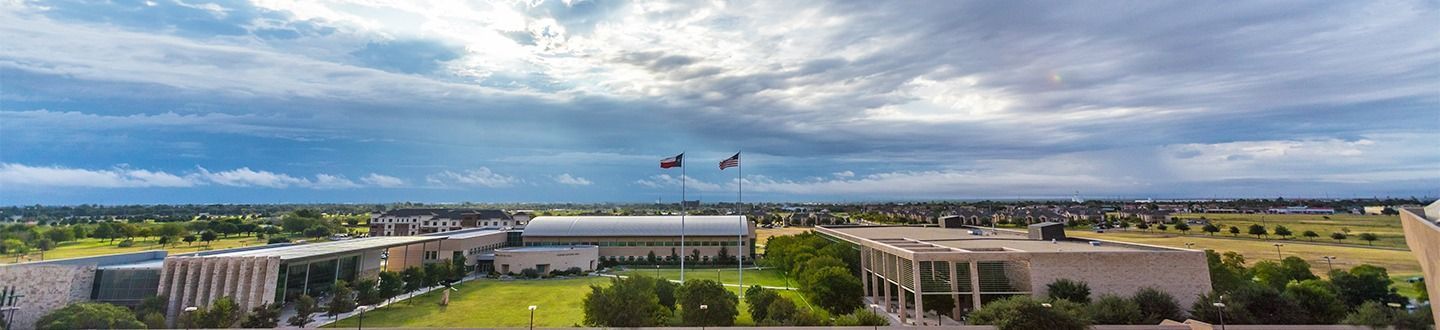
recent years as the University’s new instructional buildings, the first to be built in 25 years, completely changed the horizon of
the campus. In June 1997, House Bill 1235 approved $25.8 million
in tuition revenue bonds for the construction of the state-of
the-art $4.1 million Visual Design Studios, an 80,000 square-foot
two-story $15.7 million Library/Lecture Center, and an $870,000
renovation of a lobby area of the main Mesa Building as well
as a retrofit of the energy plant. With these changes came
new sidewalks, large trees, landscaping, a water feature near
the library, a boulevard entrance to the library, and a 100-space
parking lot joined the Devonian parking lot by a landscaped
“turn-around.” A new Student Union was constructed as well. The addition of student housing has changed the landscape of campus as well as the quality of campus life.
Dependent on the oil industry for many years, the local chambers
of commerce are attracting diverse businesses to
the area. In the past five years, a flourishing retail boom
brought in many restaurants, and shopping centers to Midland
and Odessa. Museums, theatres, a symphony, golf courses, a
Texas League AA professional stadium, football stadiums, ice
hockey, a polo club, international airport, and other metropolitan
attractions are all within minutes of the University. The
semi-arid grassland climate averages 300 days of sunshine
a year, boasts wide-open spaces and spectacular sunsets. Even
better than the sunny climate is that positive “can-do” attitudes
abound.
|